

Make your next move your best one.

Whether you’re trading up, trading down or relocating, we’ll structure the right mortgage move for you at no cost to you.
Not sure where to start? Book a free call

We can help if...
- Your family is growing so you need a bigger home
- You're looking to downsize your home to fit your needs
- You're relocating for work or lifestyle
- You're considering keeping your current home as an investment property
We work with all major lenders in Ireland to secure the best mortgage rate for you.








How we work
Working with IMC is really simple, from a quick call to final approval, we’re there to guide you
Initial assessment
We’ll assist with documents research and advise
Formal Assessment
We’ll prepare and submit your application
Mortgage protection
We’ll help you protect your investment
Loan offer
We’ll help you understand your loan offer in plain English
Mortgage Cheque Issued
We’ll coordinate with your solicitor and lender to ensure your funds are released on time
Your options when moving
Whether you’re upgrading or downsizing, moving homes can be a busy and stressful time. Our specialized team of experts will navigate and simplify the complex mortgage process.
Sell your existing home and take out a new mortgage
In this scenario, your mortgage usually focuses on the next home, and the key factor is lining up the sale, purchase and finance, so the chain closes smoothly.
Keep your existing home and buy another
If you’re keeping your existing property and buying a new one, you’ll usually need to show you can support two properties financially, which means lenders will look closely at equity, rental income if relevant, and overall affordability.
Switch lender as part of moving
You can switch lender as part of moving, and many borrowers do if a better rate or cashback makes sense. It usually means a fresh mortgage application with the new lender, plus legal work and a valuation, so it can take a bit longer than simply moving your current mortgage.
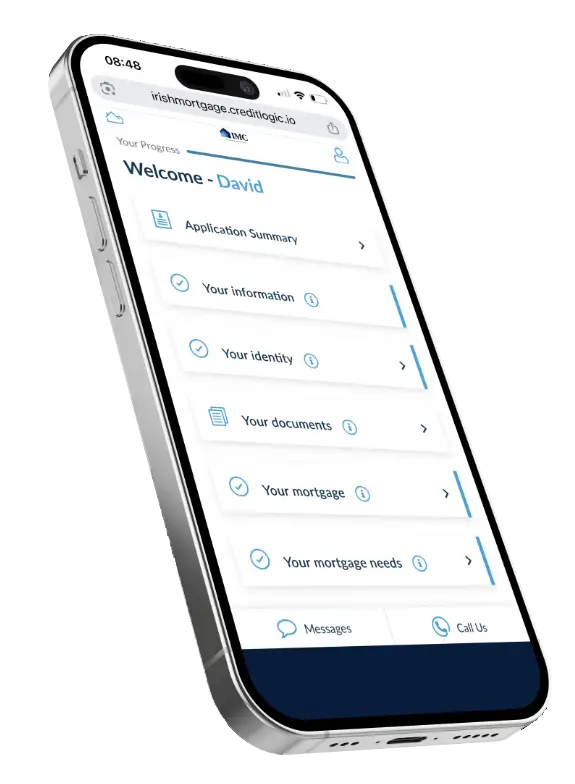
DIGITAL MORTGAGE PORTAL
Why movers work with us
A fully digital mortgage portal, with real people behind it.
Track your application in one place, in real time, while an expert IMC advisor:
- Guides you from first chat to keys
- Works to secure the best available rate for you
- Handles the communication with both lenders and your solicitor so you can have peace of mind
Real savings, real clients
We have an excellent rating on Google & Trustindex and Access to all main lenders and best available rates.
Read some of the reviews we’ve received from satisfied homeowners nationwide.

Posted on Google
 Edward L19 October 2026
Trustindex verifies that the original source of the review is Google.
Fantastic ability to resolve our complex mortgage needs. Liam and team are top class and I couldn’t recommend them highly enough.Posted on Google Lyndsey M19 October 2026I can’t recommend IMC enough! Paddy and the team were incredibly helpful, informative, and supportive from the very beginning of the process. They were always available to answer any questions we had and were so efficient and easy to deal with throughout. Everything was handled quickly and professionally, with no unnecessary delays. We couldn’t have asked for a smoother process and are so grateful for all their help.Posted on Google
 Darragh K19 October 2026Michelle, Zoe & the whole team were fantastic to deal with from start to finish. Super service!Posted on Google
 Neil M17 October 2026Very helpful, simplified the whole process, I would recommend IMC to anyonePosted on Google
 Нина Г17 October 2026Luke handles our issue very quickly, accurately, professionally, and respectfully. I really appreciate how competently and promptly he takes care of everything. We are very grateful to him for his excellent work! A big thank you from all of us!Posted on Google
 Siobhan T17 October 2026Excellent service. They have a broad knowledge of the various mortgage products on the market and make the process as stress free as possible.Posted on Google
 Conor N17 October 2026Really helpful. Guide you through your application and the process. Takes the mystery out of mortgagesPosted on Google
 Kamil S16 October 2026I highly recommend this mortgage broker. From the very beginning, they were professional, helpful and easy to communicate with. They explained the whole mortgage process clearly and were always available to answer my questions. One of the things I really appreciated was that everything could be handled through their website. Documents could be uploaded online, so there was no need to print everything or send paperwork by post. This made the whole process much quicker, easier and more convenient. They made what could have been a stressful process much easier and guided me through every step, from the initial application to getting the mortgage approved. I really appreciated their patience, knowledge and commitment to finding the best solution for me. Excellent service from start to finish. I would definitely recommend them to anyone looking for a mortgage broker. Kind Regards.Posted on Google
 Mark M14 October 2026Ciaran was exceptional! He made sure I always knew what documents were needed and did all the leg work. In the end he got me more than I even thought possible which was great! Can’t recommend them highly enough!Posted on Google
 Cynthia B14 October 2026We cannot thank Irish Mortgage Corporation enough for their time, patience and support they have given me and my partner throughout our whole experience. What we were expecting to be a very daunting time as it was our first time applying for a mortgage and purchasing a house, we didn’t know where to begin, IMC helped us from start to finish and made the experience so easy and stress free. And especially Graham and Zoe who did everything they could to help and guide us along the way, they were so lovely and kind to work with. I would recommend IMC to anyone who is thinking about applying for a mortgage. My partner and I have just purchased our first home and it is all thanks to Graham and Zoe at IMC. Thanks so much again, we are so thrilled and we could not have done it without you.Posted on Google
 Melissa M13 October 2026We had such an amazing experience with the Irish Mortgage Corporation team. Paddy and Mel were amazing and were so quick to respond whenever we had a question. Thank you both so much for all of your work. We felt so supported in the process of buying our first home, and the team made the process feel so easy and simplified. I would highly recommend using IMC for your mortgage!Posted on Google
 Владимир С13 October 2026Excellent service from Irish Mortgage Corporation! The team was very helpful, professional, and friendly throughout the whole process. They explained everything clearly and made everything much easier. I really appreciate their support and would highly recommend them to anyone looking for mortgage advice!Posted on Google
 Wendy W12 October 2026I highly recommend Irish mortgage corporation and my advisor Michael Rogers. From start to finish Michael was incredibly helpful always quick to respond and made a very daunting mortgage process feel much more manageable. I really appreciated all the support and guidance along the way.Posted on Google
 Sandra J12 October 2026Ciara, our broker has been fantastic so far, it's great to have someone who knows what they're doing to help you every step of the way. The mortgage process is complicated so it would be nightmare on our own!Posted on Google
 Louis B12 October 2026Very happy with the service, all communication very clear and timely, would recommend to family and friendsPosted on Google
 Cathal R12 October 2026I delt with Daniel in IMC and he was extremely helpful and knowledgeable. Can't recommend him highly enough!Posted on Google
 Geraldine H12 October 2026Ciaran and Mary were a pleasure to deal with. They really went above and beyond with our application process and their response to any queries we had were addressed immediately every time. We can’t thank them enough. Would highly recommend.Posted on Trustindex
 Adrian L11 October 2026
Verified
Mortgage Application Process excellent service and very prompt alsoPosted on Google Caroline H11 October 2026Eoin Clifford and the team at Irish Mortgage Corporation have provided another exceptional service. This is the second time that we have used them, and the process was seamless from start to finish. Expert guidance and excellent support throughout the entire process, eases what can otherwise be a very stressful undertaking. Thank you! We highly recommend them!Posted on Google
 Mary D10 October 2026Irish Mortgage Corporation was recommended to me by a friend, and as a first-time buyer, I honestly couldn’t recommend them highly enough! A special thank you to both Paddy and Mel, who made the entire process so much easier and less stressful for me. They were both incredibly attentive, always quick to respond, and an absolute pleasure to deal with.Posted on Google
 Ankit A10 October 2026We had an excellent experience with IMC, and Joey was fantastic throughout the entire process. He was professional, supportive, and responsive. He made what could have been a stressful process much smoother and gave me confidence at every stage. I would highly recommend Joey and the team to anyone looking for a reliable and trustworthy mortgage broker. Excellent service from start to finish!Posted on Google
 Fiona B10 October 2026My sister and I reached out to Ciara following recommendation from others. I could not recommend her and Irish Mortgage Corporation enough! We went into with very little knowledge and Ciara was so helpful and patient with us throughout the process. She was very quick to come back to my first email and in less than a month had full approval completed. Ciara was excellent, she always clarified information quickly and helped us to make decisions without feeling under pressure despite the time sensitive nature of it. I would encourage anyone who is looking to get a mortgage to contact Ciara, I cannot thank her enough for all her guidance!Posted on Google
 A F10 October 2026I had a great experience with the Irish mortgage corporation. Really helpful and friendly staff, they have helped all step of the way to receiving a mortgage offer.Posted on Google
 Jerrin A10 October 2026Huge thanks to IMC, especially Joe for the amazing support throughout our first property purchase in Ireland.. Joe clearly explained every step and offered practical solutions. We were shocked to receive our Loan Offer in just 3 days almost unheard of here.. Highly recommend IMC for your mortgage journey!Load moreVerified by TrustindexTrustindex verified badge is the Universal Symbol of Trust. Only the greatest companies can get the verified badge who has a review score above 4.5, based on customer reviews over the past 12 months. Read more
Answers to common questions about moving
You can talk to any of our mortgage advisors for advice for free and unbiased information or take a look at our FAQs
Can I keep my current property and buy a new one?
You can keep your current home and buy a new one, often using a “let‑to‑buy” or buy‑to‑let approach. You’ll need to show you can afford both properties, and lenders will look at your equity, income and any expected rental income, and not all lenders offer let‑to‑buy or allow early repayment charges to be waived.
What if my current home hasn't sold yet?
You can still see properties and even get loan offer/mortgage approval before your sale completes. But you’ll need a plan for how to bridge the gap if your purchase and sale don’t line up. Some people arrange short‑term bridging finance, use existing savings, or negotiate a delayed completion; lenders will want clarity on how both mortgages can be covered if there’s a period where you owe on two properties.
What are the LTV/LTI rules for moving home?
If you’re taking on new borrowing to move up (e.g. a bigger loan), you must meet the Central Bank’s LTV and LTI limits for second/subsequent buyers: usually up to 3.5× gross income and 90% LTV (10% deposit), with some lenders able to exceed these limits for a small proportion of loans. If you’re simply switching your existing mortgage without increasing the loan, LTV and LTI limits generally do not apply, as you’re not taking on new borrowing beyond your existing balance.
What costs do I need to plan for when moving?
You should budget for stamp duty (usually 1% up to €1m, 2% above that), legal/conveyancing fees, valuation and survey costs, estate agent fees (when selling), and moving expenses. You’ll also need to account for Local Property Tax on your new home and, in some cases, possible Capital Gains Tax if you’re selling a property that isn’t your main residence.
Will I have to pay any additional fees when moving?
Common fees include stamp duty, legal fees, valuation/survey fees, and potentially early redemption charges or exit fees if you’re still in a fixed‑term deal when you pay off your current mortgage. If you’re porting (moving) your mortgage, you may still face early repayment charges if you’re changing the amount or breaking part of your deal.
Moving house insight and guidance
Costs, cashback, break fees and all other mortgage switching jargon explained.










Ready for your next chapter?
If you would like to understand your options and see whether switching is worth it for you, speak with us today and we will be glad to guide you through the process.
Be in the know
Subscribe to our newsletter to get
updates on the mortgage market
as and when they happen
By clicking subscribe you agree to receive emails from Irish Mortgage Company and accept the terms of use and privacy policy
WARNINGS
If you do not keep up your repayments, you may lose your home.
If you do not meet the repayments on your credit agreement, your account will go into arrears. This may affect your credit rating, which may limit your ability to access credit in the future.
The payment rates on this housing loan may be adjusted by the Lender from time to time.
Your interest rate may increase and the amount of your mortgage repayments may increase as a result.
You may have to pay charges if you pay off a fixed rate loan early.
The entire amount that you have borrowed will still be outstanding at the end of the interest only period.
You should consider the total cost of a mortgage loan, including any potential additional cost of an incentive offered with it.